
Miears Spotlight: A.I., Deepfakes, and the Growing Importance of Verification

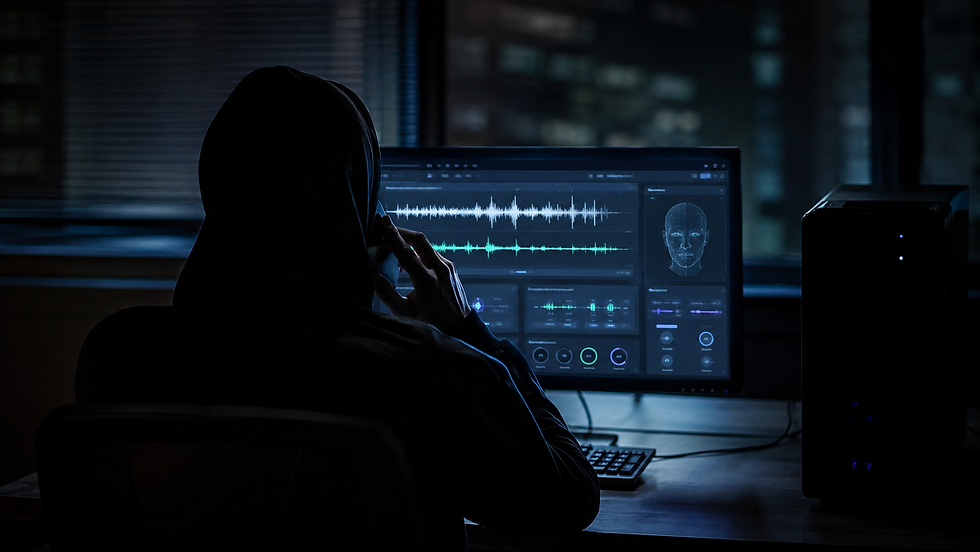
For as long as communication has existed, there have always been those who find ways to deceive others. Often, these lies and misinformation have been used to separate people from their hard-earned savings. And, alarmingly, A.I. is making it increasingly difficult to know when something is a scam.
Have you ever heard of the family emergency scam, often targeted at the elderly? This involves a scammer calling a relative, usually a grandparent, and (using information often readily available online) trying to convince the victim that they are their relative and that they are in trouble. The scammer makes the victim believe that their relative may have ended up in jail or that something happened to them while traveling. Of course, whatever the issue, it’s always solved with money. In the past, victims often suspected that the voice did not sound like their relative, but they overlooked this because of the fear and urgency that the scammer conveyed. Now, with A.I., scammers can duplicate a voice to make the scam even more believable.
But these scams aren’t only targeting perceived easy targets; they are also going after huge businesses. Just recently, “…criminals used deepfake videos to trick British engineering firm Arup into handing over $25 million.” With only a few minutes and the necessary source materials (pictures, video, and audio), scammers can create a virtual representation of someone that looks and sounds like the real thing. This is why it is becoming difficult to believe what you see and hear in the age of A.I. This doesn’t mean that we shrug and trust nothing; we just need to take more time to verify what we consume.
At Miears Investigations, we have been thinking about how these things relate to what we do every day, and it’s becoming even clearer that, in the age of A.I., interviews, records, timelines, independent witnesses, and corroborating evidence will almost always supersede one “gotcha” piece of evidence, such as a video. Investigators look for facts and inconsistencies, comparing information from multiple sources and trying to determine which parts of a story can be independently confirmed. Often, it is not one dramatic discovery that reveals the truth, but several small details that begin pointing in the same direction. This is why we’re going to have to figure out how to remain cautious and curious in the age of A.I., understanding when we need to look a little deeper… Because as technology becomes better at creating convincing falsehoods, the details become increasingly important.
Have you heard any stories about recent A.I. scams? Share your experiences with us.


Comments